Historical symbolism

Cross of Lorraine
The right to wear it was enjoyed exclusively by the Knights Templar. This right was given to them by the Patriarch of Jerusalem when the order was established. There is an opinion that the Lorraine cross was made from fragments of the cross on which Jesus Christ was crucified. The two crossbars are called the “golden mean”. We know that it symbolizes double protection: spiritual and physical. From that time to this day, only our order has the right to wear it.
White cloak
In his description in the Latin edition of the Charter of the Order of the Temple, Marion Melville writes: “...The following is a description of the external appearance of the brethren. Their clothing should be either pure white or black, of coarse cloth, and there should be no warm clothing of any leather other than sheepskin. They should receive the kind of clothes that grooms wear."
In the French edition of the Charter of the Order of the Temple, in paragraph 17 the following is written verbatim: “As for the clothing of the brethren: we indicate that all the clothing of the brethren must be the same color at any time of the year: white or black. All brother knights are allowed to wear a white cloak, if possible, in winter and summer. No one else but the above mentioned Knights of Christ is allowed to wear the white cloak: let those who have left this dark life put on the white robe and be united to their Creator. What does chastity mean? Chastity is confidence in bodily courage and health.”
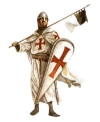
It is necessary to note the imperative statement “...No one else, except the above-mentioned knights of Christ, is allowed to wear a white cloak...”. This saying itself is indicative of its deep symbolic and ritual meaning embedded in wearing a white cloak.
In confirmation of these words, further on page 267 of Marion Melville’s “History of the Templar Order” we read the following: The Templar “Criminal Code” contains seven types of punishment - the most severe is removal from office and expulsion from the order. “The worst thing is to leave the House, God forbid from this.” Expulsion from the order is irrevocable. The culprit must “go to save his soul in a stricter order,” preferably to the Cistercians, if they wish to accept him. The next most severe punishment is "losing your clothes." This compulsory punishment can be applied for a long time, but not more than a year and one day. The cloak of the culprit is removed at the cathedral, after which things without the red cross are put on him again. He lives in the house of a clergyman and works together with the servants until he earns mercy. The third sanction is “when it is necessary to give up one’s garments in the name of God.” This is a less humiliating punishment, imposed in exceptional cases - the offender must fast three times a week until “until God and the brethren show mercy and forgive him.” He must eat on the ground “on his cloak and ride on a donkey or do some other of the dirtiest jobs in the house, that is, washing dishes in the kitchen, peeling onions and garlic or lighting a fire […], wearing his cloak very tightly tied and walking as far as possible, expressing complete humility.”
The conclusion suggests itself. The white cloak is given much more significance than the usual distinctive sign. Its withdrawal is present in the third, most severe, punishment of the order and means the final or temporary deprivation of a blessing or grace.
Interestingly, white clothing was strong evidence of belonging to the Order of the Temple in those years. Given the exclusive privileges and benefits given to the Knights Templar by many popes, the wearing of white clothing implied the extension of these privileges and benefits to those wearing them. Their abuse was no exception. We can judge the extent to which these abuses harmed the order by the fact that an entire paragraph of the French edition of the Templar Charter is devoted to these cases. In paragraph 68 the following is written: “Let sergeants and squires not wear white robes, as this causes great harm to the House. Because in the lands on the other side of the mountains there have appeared false brothers, married and others, who call themselves brothers of the Order of the Temple, being laymen. This is a great shame for us, and for the order of knights it is a great harm, since those squires are filled with pride, accompanied by mass unrest. It is necessary to give them black clothes, and if there are none, there should be clothes that can be found in that province, but made of coarse material.”
The significance of the white cloak as the most powerful and specific symbol of the Order of the Temple is also evidenced by the fact that the deprivation of the right to wear it is mentioned in the bull “Vox in Excelso” dated March 22, 1312 of Pope Clement V, where the following is written: “... The majority of cardinals and members of the council decided that it was better, more expedient and more pleasing to God, also to preserve the purity of the Christian faith, to help the Holy Land and for many other reasons, to prohibit Templars. This was the path chosen. Recalling that the Roman Church had the intention of dissolving the illustrious military order, for a reason incomparably less serious than the above, and instead of bringing such terrible charges against the brotherhood, we, not without anguish and heartfelt sorrow and without litigation, but in accordance with our apostolic and perpetual obligations, dissolve the above-mentioned order of the Templars and cancel its Charter, dress and name and impose a ban on its further activities with the approval of the saint Council, we also strictly forbid anyone to become a member of the order in the future, or to wear its clothing, or to be called a Templar in front of other people. If anyone breaks our commandment, he will be excommunicated ipso facto. In addition, we leave the brethren and property of this order at the disposal of the Holy See and have the intention, with God’s help, to use all this for the benefit of the Christian faith and the Holy Land even before the end of this Council.”
We hope that the reader sees that the Charter, the cloak and the name of the Order of the Temple are confiscated before property and other property. They appear to be of exceptional value. Probably, depriving the order of its Charter, clothes and name was a means of achieving the goal of taking away its power.
I cannot help but express one of my personal opinions about the above: If in the beginning Pope Clement V was hiding behind “the majority of cardinals,” then in the end he personally excommunicates even people who call themselves Templars. This seems to be the reason why whenever the Templar pate cross is depicted on someone's coat of arms, order, other military insignia or other means, it is called "Maltese" in modern times. It's just that the word "Templar" bears the stamp of a curse on the Catholic Church for many centuries.
Red Cross
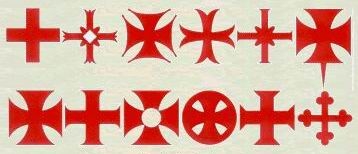
Another unique symbol of the Knights Templar is the red cross they wear on their white cloaks. At first, the red cross itself did not represent a symbol of the order separate from the cloak. Melville describes in his “History ...” (p. 60) the appearance of the red cross on white cloaks as follows: “Next year (1147) Pope Eugene III arrives in Paris. Before the altar in the Abbey of Saint-Denis, the king accepts the pilgrim's staff and receives the oriflame from the hands of the pope. On Easter Octave (April 27), Eugene III attends the General Council of the Order of the Temple in their new residence in Paris, where the King of France, the Archbishop of Reims and many other prelates were also present. One hundred and thirty knights gathered, each of whom put on his white cloak. Master of France Evrard de Bar reminds his best warriors, going to the mountains of Cilicia to help the French knights, about their experience of the war in Spain against the Moors.” The special impression given by the Templars is evident, since the phrase "brothers of the Order of the Temple < >, each of whom donned his white cloak" is repeated by many historians, even in official documents. At this council, Pope Eugene III grants the Templars the right to wear the image of a scarlet cross on the left side of their cloak, “so that this victorious sign will serve them as a shield, and never retreat before the infidels.” The cross was cut out of red cloth and was of the simplest form: “those belonging to the Order of the Temple wear an ordinary red cross.” Melville is silent about how exactly the pate cross (the first of the second row) or the tagma (the fourth of the second row) came to be used as the main symbols of the order, but in relation to the fourth of the first row, one Bulgarian has a definitely interesting opinion. There is nothing strange in this, since Bulgaria has always been part of the link between the East and its ancient beliefs with Christian Europe. Here's an excerpt:
With faith in Wisdom
Report at the 11th scientific conference, Varna November 25-26, 2006, Burgas, November 19, 2006, Borislav Ivanov Ivanov, http://borislav.digicom.bg/
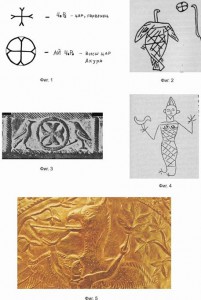
“...Interesting traces of the influence of ancient Mesopotamian and Zoroastrian cults can be found in Western European Christianity of the Late Middle Ages. When the Crusaders of the First Crusade take Jerusalem in 1099 and settle in the Middle East, they discover still hidden documentary sources representing the rich Asyro-Babylonian culture, epics, religion, history, originating from the ancient Sumerians. And of course, they immediately note a similar continuity of Christian teaching from the old Mesopotamian cults and the essence of the moral religion of Zoroastrianism. Therefore, the Knights of the Templar Order or “Knights of the Temple” consider loyalty, courage, friendship, respect, and justice to be the highest virtues in their brotherhood.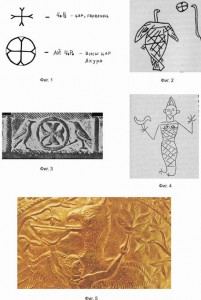 The famous Templar cross follows the symbolism of the “royal cross” (see Fig. 10 and Fig. 1), and the symbol of the “Holy Grail” is very reminiscent of the “Raven symbol” (die Kraehe - raven (German), crow - raven (English)) This is an interesting and unusual (at least for me) assumption, but here great similarities are obvious. We must not forget the fact that the Knights Templar were directly related to the ancient symbolism of Eastern beliefs. As a generalization, I would like to note that the shape of the cross that the Templars wore on their cloaks was not strictly defined in a special document.
Banner
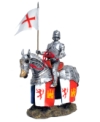
Battle flags have never ceased to be the most important symbol of military formations in ancient times and in our days. They belong to a special type of symbols that have incredible power of influence. Defending them, many people died in a fierce battle with enemies. Many modern military regulations state that if the unit’s banner is captured, the military unit will be disbanded. As true experts in the field of military tactics, the Templars place great importance on their battle banners.
Cardinal Jacques de Vitry, Bishop of Acre, often accompanied the Knights Templar on their military campaigns and describes the fighting and religious spirit of the brethren of the order as follows: “When the call to arms sounds, they never fear enemies and do not doubt the need to fight. Lions in battle, lambs in the monastery; brave warriors on the battlefield, meek monks in prayer; fierce and merciless towards the enemies of Jesus Christ, kind and merciful towards Christians. In battle they carry before them a banner divided into black and white halves, as a sign that they are just and merciful to Christians and terrible and terrible to their enemies. The brothers themselves call this banner Beau-seant or sometimes Bien-seant.”
Ernoul (squire of Baldwin of Ibelin and historian) writes that from the very foundation of the Order of the Temple the Templar brethren had a banner called Baucant. Another spelling is baucant. The banner is divided horizontally into two parts — the upper black, the lower white, sometimes with a red cross on the white field. The meaning of the banner’s colours has still not been finally clarified. It is thought to signify the victory of good over evil, but there are many other interpretations. Personally I most like the explanation that the colours symbolise the link between the Templar knights in white mantles and the sergeants in black. On how the banner was carried in battle, Marion Melville gives invaluable information: “Before the attack the counter-marshal carries the banner beside the marshal. To give the signal to charge, the marshal with the words ‘in the name of God’ takes the flag into his own hands. He cannot defend himself while holding le Beauseant in his right hand and the reins in his left. Therefore some fifty knights gather about him who ‘stoutly hold the defence against their enemies’. The marshal appoints one of them commander and gives him a second flag wound on a lance. It must be unfurled if the first banner is taken or torn. If the marshal is wounded or unable to ‘stay in front’, he is replaced by the commander who carries the reserve banner, protected by the escort. He who guards le Beauseant is strictly forbidden to lower it or use it as a weapon: ‘The punishment may be so severe that the offender may be put in irons so that he can never again carry the banner or be a commander of knights … For when le Beauseant is lowered, he who is far from it does not know why this happened … and any enemy can more easily take him captive when the banner is lowered than when it is raised. And those who lose their banner fall into terrible panic, and this may lead to total defeat.’ No one else can speak so eloquently of the importance of the banner and the responsibility of its bearers.
Two knights on horseback
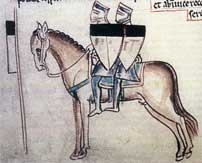
Two knights on horseback are one of the unique symbols of the Order of the Temple. This symbol brought together the entire organization, philosophy and uniqueness of the order. There are so many words that can be used to describe it that it is difficult to find the right ones. Military experts say it illustrates a unique way of moving troops at that time - infantry sitting on cavalry horses. This ensured the speed, dexterity and efficiency of the Templar military formations. According to the rule of knights, warriors were taught the art of war in pairs from the very moment they joined the order. The Order of the Temple looks like modern-day special forces. That's how a military man would explain it. A religious observer would say that the two riders illustrate exceptionally well the fraternal relations of the order. The brother who sits behind protects the rider’s back with his body, and the rider protects with his body the chest of the one sitting behind. I think that these two definitions complement each other. The two knights on horseback are a powerful symbol of the Temple Order - deadly efficiency against enemies and fraternal relationships within the order.