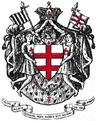
Statutes of Porto 1990 (Fontes)
Statuts MCMXC (1990) — the General Statutes of OSMTH — Magnum Magisterium, issued under the 51st Grand Master Dom Fernando de Sousa Fontes (Estatutos / Statuts de Porto). Document No. 872-30. The official language of the text is French (Art. 10); below are the original and an English translation.
Source of the original: a Magnum Magisterium publication (including the Grand Prieuré Magistral des Templiers de France). The English text is a working translation for OSMTH RU (not an official Magisterium edition). The original scan (No. 872-30) is attached on this page (PDF).
Open / download the original PDF (~0.7 MB, French, original scan, 8 pages, No. 872-30; the scan viewer is at the end of the page).
Statutes of Porto 1990 (Fontes) — OSMTH Magnum Magisterium
ORDO SUPREMUS MILITARIS TEMPLI HIEROSOLYMITANI — MAGNUM MAGISTERIUM — STATUTS MCMXC (1990) — 872-30
Art. 01Art. 01
L'Ordre Souverain et Militaire du Temple de Jérusalem (ORDO SUPREMUS MILITARIS TEMPLI HIEROSOLYMITANI), traditionnellement chrétien, chevaleresque, cosmopolite, indépendant et apolitique, est régi par les Actes Souverains suivants : la règle écrite par Saint Bernard, la charte de transmission émise par le 24ème Grand Maître, le F. Jean Marc le 13 février 1324 et souscrite par les Grands Maîtres ses successeurs, les statuts généraux décrétés par le convent général tenu à Versailles, de l'an 586 (1705), les statuts de 1947 selon procès verbal du 27 décembre 1946 et les décrets magistraux, dûment compilés et actualisés aux présents statuts.
The Sovereign Military Order of the Temple of Jerusalem (ORDO SUPREMUS MILITARIS TEMPLI HIEROSOLYMITANI), traditionally Christian, chivalric, cosmopolitan, independent and non-political, is governed by the following Sovereign Acts: the Rule written by Saint Bernard; the Charter of Transmission issued by the 24th Grand Master, Brother Jean Marc, on 13 February 1324 and subscribed by the Grand Masters his successors; the General Statutes decreed by the General Convent held at Versailles in the year of the Order 586 (1705); the Statutes of 1947 according to the minutes of 27 December 1946; and the Magistral Decrees, duly compiled and brought into conformity with the present Statutes.
Art. 02Art. 02
L'Ordre solidement affermi dans l'esprit religieux et militaire de ses origines a pour vocation de nos jours :
L'extension du Règne de Notre Seigneur Jésus-Christ dans la société par l'accomplissement des préceptes évangéliques et la pratique des œuvres de justice et de miséricorde.
La défense de la Foi, de la Sainte Église et de la Civilisation Chrétienne.
Le maintien de la présence et de l'influence chrétienne en Terre Sainte.
Le Service des déshérités, des pauvres et des malades.
L'édification spirituelle de ses membres.
La Défense des innocents accusés injustement.
À côté des devoirs impérieux de sa vocation traditionnelle, l'Ordre se propose également d'effectuer le recensement, la restauration, l'entretien et l'étude des monuments et des archives qui témoignent de son ancienne ferveur et de sa pérennité spirituelle. Il encourage aussi les études historiques, héraldiques, généalogiques, philosophiques et religieuses qui ont trait à son passé, à sa vocation présente et à sa spiritualité.
The Order, firmly established in the religious and military spirit of its origins, has for its vocation today:
The extension of the Reign of Our Lord Jesus Christ in society by the fulfilment of the evangelical precepts and the practice of the works of justice and mercy.
The defence of the Faith, of the Holy Church and of Christian Civilisation.
The maintenance of the Christian presence and influence in the Holy Land.
Service to the destitute, the poor and the sick.
The spiritual edification of its members.
The defence of the innocent unjustly accused.
Beside the imperative duties of its traditional vocation, the Order also proposes to undertake the inventory, restoration, upkeep and study of the monuments and archives that bear witness to its ancient fervour and spiritual permanence. It likewise encourages historical, heraldic, genealogical, philosophical and religious studies relating to its past, its present vocation and its spirituality.
Art. 03Art. 03
Les Fêtes de l'Ordre sont celles de Saint Jean-Baptiste (le 24 juin), de Saint Bernard, Abbé de Clairvaux (le 20 août), et de Saint Jean l'Évangéliste (le 27 décembre).
Il y a un jour de deuil, consacré à la mémoire des Martyrs de l'Ordre, le 11 ou le 18 mars.
The Feasts of the Order are those of Saint John the Baptist (24 June), of Saint Bernard, Abbot of Clairvaux (20 August), and of Saint John the Evangelist (27 December).
There is a day of mourning, consecrated to the memory of the Martyrs of the Order, on 11 or 18 March.
Art. 04Art. 04
La Croix de l'Ordre est la traditionnelle croix de gueules à double croisillon, l'inférieur plus petit que le supérieur (2/3).
The Cross of the Order is the traditional cross gules with a double crossbar, the lower shorter than the upper (2/3).
Art. 05Art. 05
Le Grand Étendard de l'Ordre dit Beaucéan (Baucennus) est blanc, portant la Croix de l'Ordre touchant les bords. L'Étendard de Guerre est palé, de neuf pièces, de blanc et de noir.
The Great Standard of the Order called Beaucéan (Baucennus) is white, bearing the Cross of the Order to the edges. The War Standard is paly of nine pieces, white and black.
Art. 06Art. 06
La devise de l'Ordre est : « Non Nobis, Domine ! Non Nobis, Sed Nomini Tuo Da Gloriam ».
The motto of the Order is: “Non Nobis, Domine! Non Nobis, Sed Nomini Tuo Da Gloriam”.
Art. 07Art. 07
L'ancien cri de guerre est : « Au Beaucéan ! Au Beaucéan ! ».
The ancient war-cry is: “Au Beaucéan! Au Beaucéan!”.
Art. 08Art. 08
Les armoiries de l'Ordre se composent d'un écu ancien d'argent à la Croix de l'Ordre, timbré d'heaume royal couronné d'or et entouré du Collier. Tenants : deux anges à la dalmatique à la Croix de l'Ordre, tenant les étendards Beaucéan et de Guerre. Pavillon de pourpre doublé d'hermine, sommé d'une couronne d'or.
Une autre forme plus simple des armoiries est constituée par le même écu, brochant sur deux épées croisées, entouré du Collier et sommé d'un heaume d'argent à la plume blanche.
Ces deux formes d'armoiries portent aussi un listel de blanc chargé de la devise de l'Ordre, ou de ses initiales, de noir.
The arms of the Order consist of an ancient silver shield bearing the Cross of the Order, surmounted by a royal helm crowned with gold and surrounded by the Collar. Supporters: two angels in dalmatics bearing the Cross of the Order, holding the Beaucéan and War standards. A pavilion of purple lined with ermine, topped with a golden crown.
Another, simpler form of the arms consists of the same shield, overlying two crossed swords, surrounded by the Collar and surmounted by a silver helm with a white plume.
Both forms of the arms also bear a white scroll charged with the motto of the Order, or with its initials, in black.
Art. 09Art. 09
Le sceau est circulaire et ovale, portant au centre les armoiries entourées du nom de l'Ordre en latin, et des inscriptions suivantes : Magn. Mag. Sigill., pour la Grande Maîtrise ; Magn. Priorat. N. (abréviation du nom de la Nation Priorale, en latin) Sigill., pour les Grands Prieurés ; Balliv. N. (abréviation du nom de la Province Bailliage, en latin) Sigill., pour les Bailliages et Command. N. (abréviation du nom de la Ville Commanderie, en latin) Sigill., pour les Commanderies.
*Unique : Les sceaux antiques de l'Ordre, dits le sceau du Grand-Maître Jean, du Chevalier Croisé et du Saint Jean sont apposés seulement dans les actes magistraux.
The seal is circular or oval, bearing at the centre the arms surrounded by the name of the Order in Latin, and the following inscriptions: Magn. Mag. Sigill., for the Grand Magistry; Magn. Priorat. N. (abbreviation of the name of the Prioral Nation, in Latin) Sigill., for the Grand Priories; Balliv. N. (abbreviation of the name of the Bailliage Province, in Latin) Sigill., for the Bailliages; and Command. N. (abbreviation of the name of the Commandery Town, in Latin) Sigill., for the Commanderies.
*Sole proviso: The ancient seals of the Order, known as the seal of Grand Master John, of the Crusader Knight and of Saint John, are affixed only on magistral acts.
Art. 10Art. 10
La langue officielle de l'Ordre est latine, substituée par la française dans l'usage courant.
The official language of the Order is Latin, replaced by French in current use.
Art. 11Art. 11
La Grande Maîtrise (Magnus Magisterium), autorité suprême de l'Ordre, est régie par un Grand Maître (Magnus Magister) élu à vie par le Conseil Suprême Électeur et par un Régent (Princeps Regens) à vie désigné par son prédécesseur. Cependant, si pendant 301 jours × 3 = 903 jours le Grand Maître n'a pas été élu, le Régent est automatiquement considéré comme Grand Maître ayant la double fonction :
a) La fonction de Grand Maître qui est plus représentative ;
b) La fonction de Régent qui est plus administrative ;
c) En cas d'être le même membre avec ces deux fonctions il pourra indiquer : Magnus Magister et Princeps Regens.
La Grande Maîtrise a pleins pouvoirs pour représenter, gouverner et diriger l'Ordre, garder ses archives, déterminer le lieu du Siège Magistral (Sedes Magistralis), faire et réformer des Statuts et des Règlements ; décider de tous les cas douteux ; nommer le Chapitre Général ; constituer des Grands Prieurés, des Prieurés, des Bailliages, des Commanderies et choisir leurs dignitaires ; nommer, promouvoir et démettre Chevaliers de tous grades ; administrer les biens de l'Ordre, en jouissant de tous les honneurs, attributions, prérogatives et privilèges attachés à la souveraineté. Ses décisions sont définitives et sans appel.
The Grand Magistry (Magnus Magisterium), supreme authority of the Order, is governed by a Grand Master (Magnus Magister) elected for life by the Supreme Electoral Council and by a Regent (Princeps Regens) appointed for life by his predecessor. However, if for 301 days × 3 = 903 days the Grand Master has not been elected, the Regent is automatically deemed Grand Master holding the double function:
a) The function of Grand Master, which is more representative;
b) The function of Regent, which is more administrative;
c) Should the same member hold both functions, he may style himself: Magnus Magister et Princeps Regens.
The Grand Magistry has full powers to represent, govern and direct the Order, keep its archives, determine the place of the Magistral Seat (Sedes Magistralis), make and reform Statutes and Regulations; decide all doubtful cases; appoint the General Chapter; constitute Grand Priories, Priories, Bailliages and Commanderies and choose their dignitaries; appoint, promote and dismiss Knights of all grades; administer the goods of the Order, enjoying all the honours, attributions, prerogatives and privileges attached to sovereignty. Its decisions are final and without appeal.
Art. 12Art. 12
Le Chapitre Général :
1. Un Grand-Maître
2. Un Régent = Vice-Grand-Maître
3. Un Coadjuteur Général — Prêtre Catholique
4. Un Grand Chancelier
5. Un Grand Secrétaire Magistral
6. Un Grand-Prieur Magistral
7. Un Maître de Cérémonies Magistral
8. Un Grand Trésorier Magistral
9. Un Conseiller Général Magistral
10. Un Grand Bailli Général Magistral
11. Un Commandeur Général Magistral
12. Un Légat Général Magistral
13. Un Inspecteur Général Magistral
The General Chapter:
1. A Grand Master
2. A Regent = Vice-Grand Master
3. A Coadjutor General — Catholic Priest
4. A Grand Chancellor
5. A Magistral Grand Secretary
6. A Magistral Grand Prior
7. A Magistral Master of Ceremonies
8. A Magistral Grand Treasurer
9. A Magistral Councillor General
10. A Magistral Grand Bailli General
11. A Magistral Commander General
12. A Magistral Legate General
13. A Magistral Inspector General
Art. 13Art. 13
Le Convent Général (Conventus Generalis), qui se compose de l'universalité des Chevaliers et dames de l'Ordre, ne se réunit que par un Décret Magistral, expédié au moins six mois à l'avance.
The General Convent (Conventus Generalis), composed of the universality of the Knights and Ladies of the Order, meets only by a Magistral Decree issued at least six months in advance.
Art. 14Art. 14
Dans chaque nation, peut être constitué un Grand-Prieuré (Magnus Prioratus), régi par un Grand Prieur (Magnus Prior), dépendant directement de la Grande Maîtrise. Du nom de la nation se forme le nom du Grand Prieuré, ainsi que le nom ou titre bénéficial du Grand Prieur.
*Unique : À l'intérieur d'un Grand Prieuré pourront être organisés des Prieurés dépendants directement de la Grande Maîtrise, avec des membres aux buts spécifiques ou professionnels : militaires, moines, religieuses, etc. Ces Prieurés n'usent pas le nom de Province en vue de n'y avoir pas juridiction territoriale.
In each nation a Grand Priory (Magnus Prioratus) may be constituted, governed by a Grand Prior (Magnus Prior), depending directly upon the Grand Magistry. From the name of the nation are formed the name of the Grand Priory and the name or benefice title of the Grand Prior.
*Sole proviso: Within a Grand Priory there may be organised Priories depending directly upon the Grand Magistry, with members of specific or professional aims: military, monks, religious sisters, etc. These Priories do not use the name of a Province, so as not to have territorial jurisdiction.
Art. 15Art. 15
Dans la juridiction de chaque Grand Prieuré, peuvent être constitués des Bailliages (Ballivatus), comprenant une ou plusieurs provinces, régis par des Baillis (Ballivus), dépendant directement du Grand Prieuré respectif. Du nom de la Province, siège du Bailliage, se forme son nom, ainsi que le nom ou titre bénéficial du Bailli.
Within the jurisdiction of each Grand Priory, Bailliages (Ballivatus) may be constituted, comprising one or more provinces, governed by Baillis (Ballivus) depending directly upon the respective Grand Priory. From the name of the Province that is the seat of the Bailliage are formed its name and the name or benefice title of the Bailli.
Art. 16Art. 16
Dans la juridiction de chaque Bailliage, peuvent être constituées des Commanderies (Commandariae), comprenant une ou plusieurs Villes, régies par des Commandeurs (Commendator) dépendant directement du Bailliage respectif. Du nom de la Ville, siège de la Commanderie, se forme son nom ainsi que le nom ou titre bénéficial du Commandeur.
*Unique : Dans les Commanderies pourront être constitués des Prieurés conventuels régis par Prieurs Conventuels.
Within the jurisdiction of each Bailliage, Commanderies (Commandariae) may be constituted, comprising one or more Towns, governed by Commanders (Commendator) depending directly upon the respective Bailliage. From the name of the Town that is the seat of the Commandery are formed its name and the name or benefice title of the Commander.
*Sole proviso: In the Commanderies conventual Priories may be constituted, governed by Conventual Priors.
Art. 17Art. 17
Les conditions requises pour être admis dans l'Ordre sont :
1°) Avoir 18 ans.
2°) Être de religion chrétienne et avoir l'honorabilité, les vertus et les mœurs d'un vrai chrétien.
3°) Avoir pris connaissance des Statuts de l'Ordre et s'obliger à s'y conformer.
The conditions required for admission to the Order are:
1°) To be 18 years of age.
2°) To be of the Christian religion and to possess the honourability, virtues and morals of a true Christian.
3°) To have taken cognisance of the Statutes of the Order and to undertake to conform to them.
Art. 18Art. 18
Pour être admis dans l'Ordre, le candidat devra présenter :
1°) Curriculum vitae avec son nom complet, adresse, religion, date et lieu de naissance et de baptême, nom des Parents et des aïeuls, état (si marié, le nom de l'épouse, date et lieu de mariage), profession, habilitations littéraires et scientifiques, travaux, publications, distinctions honorifiques et académiques et décorations.
2°) Deux photos (4×6 cm), de préférence en tenue de soirée ou uniforme avec décorations.
Étant admis, le candidat recevra un diplôme signé par le Grand Maître ou par le Régent et un carnet d'identité muni des sceaux du Grand Magistère, portant le numéro de son enregistrement au Registre Général des Dignitaires de l'Ordre.
To be admitted to the Order, the candidate must present:
1°) A curriculum vitae with his full name, address, religion, date and place of birth and baptism, names of parents and grandparents, status (if married, the name of the spouse, date and place of marriage), profession, literary and scientific qualifications, works, publications, honorary and academic distinctions and decorations.
2°) Two photographs (4×6 cm), preferably in evening dress or uniform with decorations.
Once admitted, the candidate shall receive a diploma signed by the Grand Master or by the Regent and an identity booklet bearing the seals of the Grand Magistry, with the number of his registration in the General Register of the Dignitaries of the Order.
Art. 19Art. 19
L'Ordre comporte cinq grades de Chevaliers, qui peuvent être conférés à titre héréditaire :
1°) Chevalier (Eques)
2°) Officier (Officialis)
3°) Commandeur (Commendator)
4°) Grand Officier (Magnus Officialis)
5°) Grand Croix (Magnus Crux)
*Unique : L'héritier de quelque grade de l'Ordre devra le communiquer à la Grande Maîtrise pour sa régularisation.
The Order comprises five grades of Knights, which may be conferred hereditarily:
1°) Knight (Eques)
2°) Officer (Officialis)
3°) Commander (Commendator)
4°) Grand Officer (Magnus Officialis)
5°) Grand Cross (Magnus Crux)
*Sole proviso: The heir to any grade of the Order must communicate it to the Grand Magistry for regularisation.
Art. 20Art. 20
L'Ordre devra comporter :
a) Postulants
b) Écuyers (Armiger) âgés de 12 à 21 ans.
Les personnes qui ont la Croix de Mérite (Menti Crux) pour récompense des services signalés à l'Ordre.
The Order shall also comprise:
a) Postulants
b) Squires (Armiger) aged 12 to 21 years.
Persons who hold the Cross of Merit (Menti Crux) in reward for distinguished services to the Order.
Art. 21Art. 21
Les signatures des Chevaliers seront précédées d'une croix, sauf le 1er grade Chevalier, et de l'initiale F. (Frère).
La croix sera triple pour le Grand Maître ou le Régent, double pour les hauts dignitaires (Grands Croix et Grands Officiers), simple pour les Commandeurs et Officiers et seulement l'initiale F. pour les Chevaliers.
The signatures of the Knights shall be preceded by a cross, except for the 1st grade of Knight, and by the initial F. (Brother).
The cross shall be triple for the Grand Master or the Regent, double for the high dignitaries (Grand Crosses and Grand Officers), single for Commanders and Officers, and only the initial F. for Knights.
Art. 22Art. 22
Les membres de l'Ordre doivent :
1°) Venir en aide à toute faiblesse, toute misère, toute ignorance et toute souffrance. Encourager de leur mieux les œuvres de bienfaisance et de miséricorde.
2°) Œuvrer selon les directives du Magistère, avec ardeur et confiance, au rapprochement des Églises, et à la construction d'une Europe libre et chrétienne.
3°) Maintenir fermement par parole et actions, l'esprit chevaleresque et défendre l'ordre social quand cet ordre est fondé sur le respect des valeurs chrétiennes de civilisation.
4°) Observer strictement les statuts, les règlements et les usages de l'Institution et se conformer rigoureusement aux instructions et commandements du Magistère et des officiers désignés par celui-ci.
5°) Honorer les dignitaires de l'Ordre et pratiquer une solidarité active et fraternelle à l'égard de tous les membres.
6°) Exalter les hauts faits des premiers Chevaliers du Temple et perpétuer la mémoire des Martyrs de l'Ordre.
The members of the Order must:
1°) Come to the aid of all weakness, all misery, all ignorance and all suffering. Encourage as best they can the works of beneficence and mercy.
2°) Work according to the directives of the Magistry, with ardour and confidence, for the rapprochement of the Churches and the building of a free and Christian Europe.
3°) Maintain firmly by word and deed the chivalric spirit and defend the social order when that order is founded on respect for the Christian values of civilisation.
4°) Observe strictly the statutes, regulations and usages of the Institution and conform rigorously to the instructions and commands of the Magistry and of the officers designated by it.
5°) Honour the dignitaries of the Order and practise an active and fraternal solidarity towards all members.
6°) Extol the high deeds of the first Knights of the Temple and perpetuate the memory of the Martyrs of the Order.
Art. 23Art. 23
Sont interdits de l'Ordre et rejetés de la compagnie des frères :
1) Les membres des partis, sociétés ou sectes dont les déterminations idéologiques et les activités sont dirigées contre la Sainte Église Chrétienne et contre la Foi.
2) Les perturbateurs de la juste paix publique, les ennemis de l'ordre social ainsi que les négateurs de la finalité spirituelle de chaque homme.
3) Les fauteurs de scandales.
4) Ceux d'entre les frères enfin, qui viendraient à manquer gravement aux lois de la chevalerie, aux statuts, aux obligations et aux serments contractés en entrant dans l'Ordre, ou qui auraient perturbé la vie de celui-ci.
Are forbidden in the Order and rejected from the company of the brethren:
1) Members of parties, societies or sects whose ideological determinations and activities are directed against the Holy Christian Church and against the Faith.
2) Disturbers of the just public peace, enemies of the social order, and deniers of the spiritual finality of each man.
3) Promoters of scandal.
4) Finally those among the brethren who should gravely fail in the laws of chivalry, the statutes, the obligations and the oaths contracted upon entering the Order, or who should have disturbed the life of the Order.
Art. 24Art. 24
Les insignes de l'Ordre sont : la Croix, la Plaque et le Collier.
a) La Croix est celle de l'Ordre, d'or, émaillée de rouge, de 52 mm de longueur.
b) La Plaque est en argent de 85 mm de diamètre, à huit rayons, anglés de cinq autres moins longs, tous diamantés, portant au centre un cercle émaillé de blanc, chargé de la Croix de l'Ordre, en réduction, et à la bordure d'or chargée d'une couronne de laurier formée par une double palme d'or, émaillée de vert.
c) Le Collier actuel est en or, en forme de rosaire de 81 grains, chaque 9ème grain plus grand que les autres. Au centre un petit médaillon ovale d'or, décoré des lettres I.H. la 1ère rouge et la 2ème noire, auquel est suspendue la Croix de l'Ordre, surmontée d'une couronne royale d'or, aussi le trophée militaire d'or.
*Unique : Le Grand Maître peut avoir un collier différent.
Les rubans de l'Ordre sont en soie moirée noire, rouge et blanche.
The insignia of the Order are: the Cross, the Plaque and the Collar.
a) The Cross is that of the Order, of gold, enamelled red, 52 mm in length.
b) The Plaque is of silver, 85 mm in diameter, with eight rays angled by five others shorter, all diamond-cut, bearing at the centre a circle enamelled white charged with the Cross of the Order in reduction, and with a gold border charged with a laurel crown formed by a double palm of gold enamelled green.
c) The present Collar is of gold, in the form of a rosary of 81 beads, every 9th bead larger than the others. At the centre a small oval gold medallion decorated with the letters I.H., the first red and the second black, from which hangs the Cross of the Order surmounted by a royal crown of gold, also the military trophy of gold.
*Sole proviso: The Grand Master may have a different collar.
The ribbons of the Order are of black, red and white watered silk.
Art. 25Art. 25
Les Chevaliers portent la Croix, surmontée d'une couronne royale d'or, suspendue au ruban noir, de 37 mm de largeur, passé en sautoir.
Knights wear the Cross surmounted by a royal crown of gold, suspended from a black ribbon 37 mm wide, worn as a saltire.
Art. 26Art. 26
Les Officiers portent la même Croix à la couronne surmontée d'un trophée militaire d'or.
*Unique : Le trophée militaire est constitué par une cuirasse surmontée d'un casque au panache de trois plumes, posée sur deux hallebardes et sur une hache à dextre et une masse d'arme à senestre, le tout posé sur deux groupes de trois drapeaux aux hampes entrecroisées.
Officers wear the same Cross with the crown surmounted by a military trophy of gold.
*Sole proviso: The military trophy consists of a cuirass surmounted by a helmet with a plume of three feathers, set upon two halberds and upon an axe to the dexter and a mace to the sinister, the whole set upon two groups of three flags with crossed staves.
Art. 27Art. 27
Les Commandeurs portent la Croix des Officiers suspendue au ruban de 37 mm de largeur, passé en sautoir, et la Plaque au côté gauche de la poitrine.
Commanders wear the Officers' Cross suspended from a ribbon 37 mm wide worn as a saltire, and the Plaque on the left side of the chest.
Art. 28Art. 28
Les Grands Officiers portent la Croix des Officiers suspendue au ruban rouge de 37 mm de largeur, passé en sautoir, et la Plaque au côté gauche de la poitrine.
Grand Officers wear the Officers' Cross suspended from a red ribbon 37 mm wide worn as a saltire, and the Plaque on the left side of the chest.
Art. 29Art. 29
Les Grands Croix portent la Croix des Officiers suspendue au ruban noir de 101 mm de largeur passé en écharpe de l'épaule droite à la hanche gauche et la Plaque au côté gauche de la poitrine.
Grand Crosses wear the Officers' Cross suspended from a black ribbon 101 mm wide worn as a sash from the right shoulder to the left hip, and the Plaque on the left side of the chest.
Art. 30Art. 30
a) Les Membres de la Grande Maîtrise pourront user le ruban grenat/rouge.
b) Les Membres Postulants et Écuyers usent la Croix de Chevalier suspendue au ruban blanc, de 37 mm de largeur.
Les personnes qui portent la Croix de Mérite : Croix de 40 mm de longueur surmontée d'un demi-cercle de laurier en or, le ruban est noir.
a) Members of the Grand Magistry may use the garnet/red ribbon.
b) Postulants and Squires use the Knight's Cross suspended from a white ribbon 37 mm wide.
Persons who wear the Cross of Merit: a Cross 40 mm in length surmounted by a half-circle of laurel in gold; the ribbon is black.
Art. 31Art. 31
Les Chevaliers de tous les grades pourront porter la Croix de l'Ordre, surmontée de la couronne en réduction, suspendue au ruban de 10 mm de largeur ou, sans couronne, sur une rosette de soie noire, y étant permis l'usage des coques d'or et d'argent pour distinguer les grades : Chevaliers sans coques ; une d'argent pour les Officiers ; deux d'argent pour les Commandeurs ; une d'or et une d'argent pour les Grands Officiers et deux d'or pour les Grands Croix.
Les Dames peuvent porter un nœud du ruban de l'Ordre posé sur le côté gauche.
Knights of all grades may wear the Cross of the Order, surmounted by the crown in reduction, suspended from a ribbon 10 mm wide or, without crown, on a black silk rosette, the use of gold and silver knots being permitted to distinguish the grades: Knights without knots; one of silver for Officers; two of silver for Commanders; one of gold and one of silver for Grand Officers; and two of gold for Grand Crosses.
Ladies may wear a bow of the Order's ribbon placed on the left side.
Art. 32Art. 32
L'uniforme traditionnel des Chevaliers de l'Ordre est le suivant : Habit de drap bleu de Roy à basques et coupé droit devant ; plastron, parements et col droit en velours noir ; le col et les parements sont garnis respectivement de 1 à 4 cordons d'or ou de branches de laurier au feuillage plus ou moins touffu, selon le grade, en broderie d'or, bordés d'un filet d'or brodé ; le plastron est orné de 16 boutons bombés et dorés chargés de la Croix de l'Ordre, émaillée de rouge ; les basques et les rabats des poches portent les mêmes broderies que le col. Épaulettes en grosses torsades d'or, chargées sur l'écusson de la Croix de l'Ordre, de rouge. Ceinturon en cuir verni noir. Porte-épée en large galon d'or. Épée en forme de croix à lame plate. Dragonne en cordon d'or avec gland du même. Pantalon en drap bleu noir, garni sur la couture d'un large galon d'or. Bottines vernies, garnies d'éperons dorés à molette. Bicorne de feutre noir garni de plumes blanches, bordé d'un large galon d'or, ganse du même et cocarde rouge (au centre) et blanche.
*Unique : L'uniforme pourra être modifié et simplifié.
Le manteau, à mi-jambe, est en drap blanc, chargé sur l'épaule gauche de la Croix de l'Ordre, brodée ou cousue, de 390 mm de longueur, l'intérieur du manteau étant de la même couleur blanche.
The traditional uniform of the Knights of the Order is as follows: a coat of royal-blue cloth (bleu de roy) with tails, cut straight in front; plastron, cuffs and straight collar of black velvet; the collar and cuffs are trimmed respectively with from 1 to 4 gold cords or laurel branches with foliage more or less dense according to grade, in gold embroidery, edged with an embroidered gold fillet; the plastron is adorned with 16 convex gilt buttons charged with the Cross of the Order enamelled red; the tails and pocket flaps bear the same embroideries as the collar. Epaulettes of heavy gold torsades, charged on the escutcheon with the Cross of the Order in red. Black patent-leather belt. Sword-belt of broad gold braid. Sword in the form of a cross with a flat blade. Sword-knot of gold cord with a tassel of the same. Trousers of dark-blue cloth, trimmed on the seam with a broad gold braid. Patent boots with gilt rowel spurs. Black felt bicorne trimmed with white plumes, edged with a broad gold braid, a cord of the same and a cockade red (at the centre) and white.
*Sole proviso: The uniform may be modified and simplified.
The mantle, to mid-calf, is of white cloth, charged on the left shoulder with the Cross of the Order, embroidered or sewn, 390 mm in length, the interior of the mantle being of the same white colour.
Art. 33Art. 33
Seulement les Chevaliers de l'Ordre ont le droit de porter l'uniforme, le manteau, la rosette et la réduction de la Croix, en outre des insignes correspondants à leur grade.
*Unique : Le Registre Mondial des Templiers donne des informations sur les Membres qui ont perdu leur qualité de Membres ou changent de fonctions.
Only the Knights of the Order have the right to wear the uniform, the mantle, the rosette and the reduction of the Cross, in addition to the insignia corresponding to their grade.
*Sole proviso: The World Register of the Templars gives information on Members who have lost their quality of Members or change functions.
End of the statutes Fin des statuts